Sides of 30-60-90 and 45-45-90 triangles
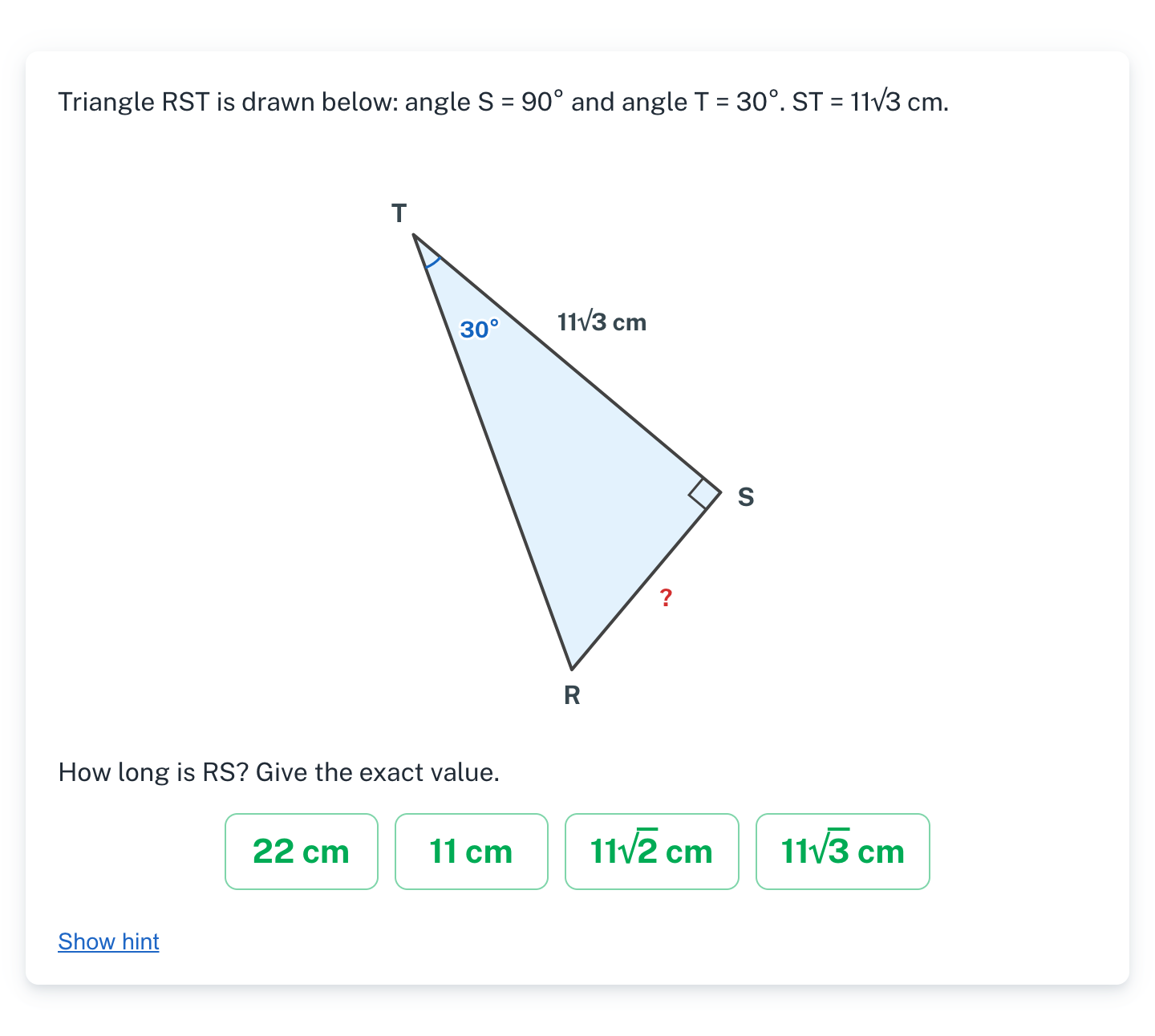
A right triangle with angles of 30°, 60° and 90°, or 45°, 45° and 90°, is drawn with one side's length marked and a question mark on the side asked. Sometimes it is a plain lettered triangle, turned any way round; sometimes it is a ramp, a ladder against a wall, a kite on its string or a square tile cut corner to corner. The student finds the side asked for as an exact value, such as 5√3, and picks it from four choices.
The method is the side pattern: in a 30-60-90 triangle the short leg, long leg and hypotenuse go x : x√3 : 2x, and in a 45-45-90 triangle x : x : x√2. Find x from the side given, then build the side asked. The usual slips are matching the pattern to the wrong side, using √2 where √3 belongs, and multiplying by a root instead of dividing; the wrong choices are those slips. When the given side is x√3 or x√2, finding x means dividing by a root, and the working shows how to clear it from the bottom. The working also finds a missing angle first when only one is given, and labels each side with its part of the pattern on the drawing.
Numbers&Me is free. Sign up to practise more, or set it as homework in under a minute, and it marks itself.
What changes each time
- Two triangles: 30-60-90 (any side given, either other side asked) and 45-45-90 (a leg to the hypotenuse, or back), with one acute angle, both, or equal legs stated
- x is a whole number from 2 to 20, or 1 to 14 times √3 or √2, so lengths such as 18, 7√3, 12√2 or 26 come up given and asked, in cm, m, mm, inches, feet or no unit
- Plain triangles with letters, turned and mirrored any way, or a ramp, a ladder, a kite string or a square tile drawn upright
More shapes and angles practice
- Sides and corners of 2D shapes (Grade 2)
- Faces, edges and vertices (Grade 3)
- Sorting quadrilaterals (Grade 3)
- Turning and flipping letters (Grade 3)
- Counting squares of every size (Grade 3)
- Inside or outside the loop (Grade 3)
- Which piece fills the gap? (Grade 3)
- Symmetry on a grid (Grade 4)
- Rotations and reflections (Grade 4)
- Reading a protractor (Grade 4)
- Parallel and perpendicular lines (Grade 4)
- Parts of a circle (Grade 4)
- Draw without lifting your pencil (Grade 4)
- Can these sticks make a triangle? (Grade 4)
- Lines, rays and line segments (Grade 4)
- Counting line segments (Grade 4)
- Triangle from two circles (Grade 4)
- Splitting an angle in half (Grade 4)
- 3D shapes: side view (Grade 5)
- Rectangle in a quarter circle (Grade 5)
- Painted cube puzzle (Grade 5)
- Rope around the Earth (Grade 5)
- Can dominoes cover the board? (Grade 5)
- Most crossing points of straight lines (Grade 5)
- Equal radii: find the missing length (Grade 5)
- Rotational symmetry: turns that look the same (Grade 5)
- Angles in a circle (Grade 6)
- Congruent triangles: match the corners first (Grade 6)
- Vertically opposite angles (Grade 6)
- Angles in a triangle: find the third angle (Grade 6)
- Faces, corners and edges: Euler's rule (Grade 6)
- Angles in parallel lines (Grade 7)
- Interior angles of a polygon (Grade 7)
- Longest side faces the biggest angle (Grade 7)
- How long can the third side of a triangle be? (Grade 7)
- Tessellation: which regular tile fills the gap (Grade 7)
- Inscribed circle in a right triangle (Grade 8)
- SSS and SAS: is it enough to prove congruence? (Grade 8)
- Shortest path over a box (Grade 8)
- Ladder over a fence (Grade 8)
- Triangle and trapezoid midsegments (Grade 8)
- Bank shots: bouncing off a wall (Grade 8)
- Acute, right or obtuse from three sides (Grade 8)
- The centroid splits a median 2 to 1 (Grade 9)
- Find the third side, then sin, cos or tan (Grade 9)
- Intersecting chords in a circle (Grade 10)