Most crossing points of straight lines
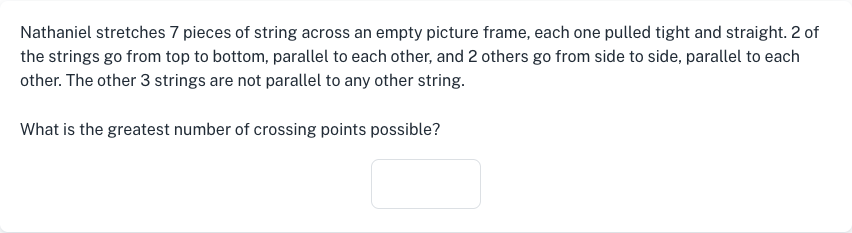
A short story gives some long straight lines: lines drawn on paper, roads in a new town, laser beams in a light show, strings across a frame or paths in a park. The student types the largest number of crossing points they can make. Some questions say that a few of the lines are parallel. Others turn it round: they give the number of crossing points and ask how many lines there are.
Two straight lines cross at most once, and parallel lines never cross. The working draws the lines one at a time: each new line can cross every line already there, so 5 lines make 1 + 2 + 3 + 4 = 10 crossing points. A line that is parallel to some of the others crosses only the rest. The usual slips are counting every crossing twice (5 × 4 = 20 instead of 10) and forgetting that parallel lines never meet.
Numbers&Me is free. Sign up to practise more, or set it as homework in under a minute, and it marks itself.
What changes each time
- Three kinds: lines crossing as often as they can, some lines in parallel groups, or the crossing points given and the lines asked for
- 2 to 8 lines, with up to three parallel groups of 2 to 4 lines going different ways; 3 to 28 crossing points when the lines are asked for
- Five settings: lines on paper, roads in a new town, laser beams, strings across a frame and paths in a park
More shapes and angles practice
- Sides and corners of 2D shapes (Grade 2)
- Faces, edges and vertices (Grade 3)
- Sorting quadrilaterals (Grade 3)
- Turning and flipping letters (Grade 3)
- Counting squares of every size (Grade 3)
- Inside or outside the loop (Grade 3)
- Which piece fills the gap? (Grade 3)
- Symmetry on a grid (Grade 4)
- Rotations and reflections (Grade 4)
- Reading a protractor (Grade 4)
- Parallel and perpendicular lines (Grade 4)
- Parts of a circle (Grade 4)
- Draw without lifting your pencil (Grade 4)
- Can these sticks make a triangle? (Grade 4)
- Lines, rays and line segments (Grade 4)
- Counting line segments (Grade 4)
- Triangle from two circles (Grade 4)
- Splitting an angle in half (Grade 4)
- 3D shapes: side view (Grade 5)
- Rectangle in a quarter circle (Grade 5)
- Painted cube puzzle (Grade 5)
- Rope around the Earth (Grade 5)
- Can dominoes cover the board? (Grade 5)
- Equal radii: find the missing length (Grade 5)
- Angles in a circle (Grade 6)
- Congruent triangles: match the corners first (Grade 6)
- Vertically opposite angles (Grade 6)
- Inscribed circle in a right triangle (Grade 8)
- SSS and SAS: is it enough to prove congruence? (Grade 8)