Triangle from two circles
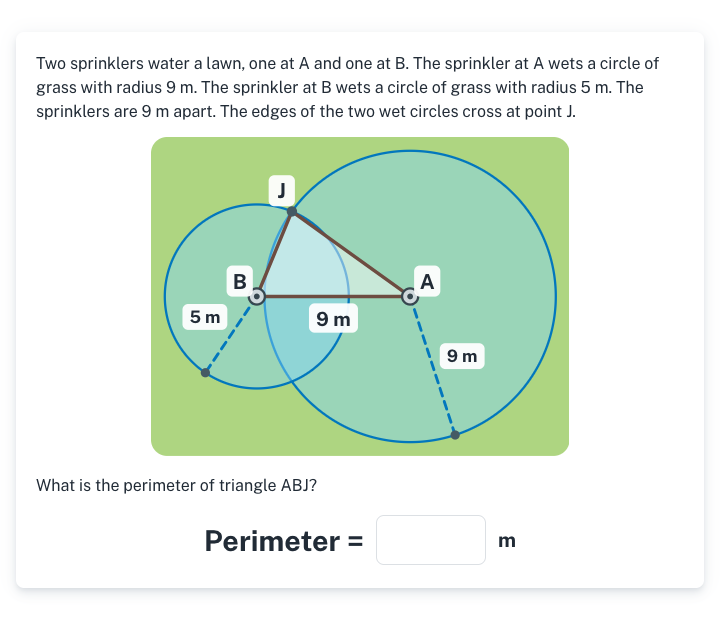
Two circles cross at a point, and the two centres and that point make a triangle. The student types one length: the triangle's perimeter, one of its sides, or, given the perimeter, the side or radius that is missing. The circles are drawn on plain paper, with a compass, in chalk on the playground, or as the wet grass round two garden sprinklers.
The key is that every point on a circle is one radius from its centre, so both sides that meet at the crossing point are radii. Not every circle comes with its radius: it may be given by its diameter, to halve; pass through the other centre, so its radius is the distance between the centres; have another point on it marked; or be the same size as the other circle. Questions that ask for one side also give lengths that are not needed. The working colours each circle and its radius on the picture, then adds the sides or takes them away.
Numbers&Me is free. Sign up to practise more, or set it as homework in under a minute, and it marks itself.
What changes each time
- The perimeter, one side, or a missing side or radius worked back from the perimeter
- Each circle given by its radius, its diameter, another point on it, passing through the other centre, or as the same size as the other
- Radii from 2 to 15 cm on paper, 2 to 8 m for chalk circles and 2 to 10 m for sprinklers
More shapes and angles practice
- Sides and corners of 2D shapes (Grade 2)
- Faces, edges and vertices (Grade 3)
- Sorting quadrilaterals (Grade 3)
- Turning and flipping letters (Grade 3)
- Counting squares of every size (Grade 3)
- Inside or outside the loop (Grade 3)
- Which piece fills the gap? (Grade 3)
- Symmetry on a grid (Grade 4)
- Rotations and reflections (Grade 4)
- Reading a protractor (Grade 4)
- Parallel and perpendicular lines (Grade 4)
- Parts of a circle (Grade 4)
- Draw without lifting your pencil (Grade 4)
- Can these sticks make a triangle? (Grade 4)
- Lines, rays and line segments (Grade 4)
- Counting line segments (Grade 4)
- Splitting an angle in half (Grade 4)
- 3D shapes: side view (Grade 5)
- Rectangle in a quarter circle (Grade 5)
- Painted cube puzzle (Grade 5)
- Rope around the Earth (Grade 5)
- Can dominoes cover the board? (Grade 5)
- Most crossing points of straight lines (Grade 5)
- Equal radii: find the missing length (Grade 5)
- Angles in a circle (Grade 6)
- Congruent triangles: match the corners first (Grade 6)
- Vertically opposite angles (Grade 6)
- Inscribed circle in a right triangle (Grade 8)
- SSS and SAS: is it enough to prove congruence? (Grade 8)