Area of a kite or rhombus from its diagonals
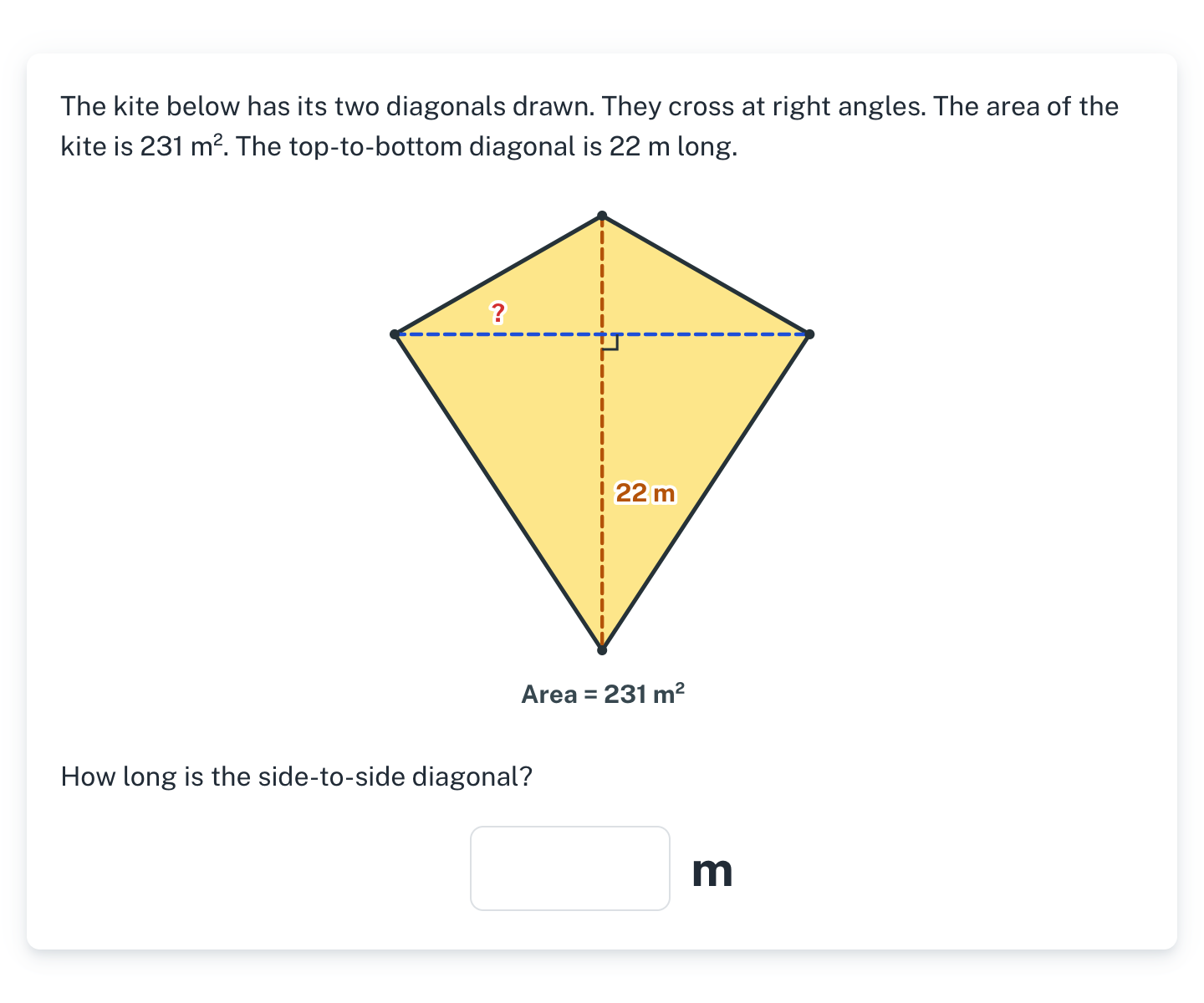
A kite or a rhombus is drawn to scale with its two diagonals crossing at right angles: a toy kite made of two sticks, a kite-shaped flower bed or badge, a rhombus floor tile, window pane, patio or piece of card. About half the questions give both diagonals and ask for the area. The rest give the area and one diagonal and ask for the other, typed as a whole number.
The area is one diagonal times the other, halved, because the shape is exactly half of the rectangle its diagonals make. Going backwards means undoing the halving first: double the area, then divide by the diagonal you know. The slip is using a length that is not a whole diagonal. Some questions give only half of a diagonal, from the crossing to one corner, or a kite's long diagonal in two unequal parts either side of the crossing, and these have to be made whole first. The step-by-step working draws the rectangle round the shape.
Numbers&Me is free. Sign up to practise more, or set it as homework in under a minute, and it marks itself.
What changes each time
- Three forms: the area from both diagonals (half the questions), or the top-to-bottom or side-to-side diagonal from the area and the other one
- Diagonals given whole, as a half from the crossing to a corner, or for a kite as two parts to add
- Whole-number diagonals from 8 to 64 cm, 6 to 36 inches, 3 to 30 m or 6 to 48 feet, with a whole-number area, in seven settings or a plain shape, and a different name each time
More area, perimeter and volume practice
- Area by counting squares (Grade 2)
- Area and perimeter of a square (Grade 3)
- Area and perimeter of a rectangle (Grade 3)
- Area with half squares (Grade 3)
- Area of an L-shape (Grade 3)
- Perimeter of an L-shape (Grade 3)
- Draw a rectangle with a given area and perimeter (Grade 3)
- Missing side of a rectangle (Grade 4)
- Rectangle sides from a ratio (Grade 4)
- Area of a right triangle (Grade 4)
- Area of an isosceles triangle (Grade 4)
- Area of a scalene triangle (Grade 4)
- Area of an irregular polygon (Grade 5)
- Missing triangle in a square (Grade 5)
- Volume by counting cubes (Grade 5)
- Water tank volume problems (Grade 6)
- Arc length and area of a sector (Grade 7)
- Surface area of two solids stuck together (Grade 7)
- Area and volume of similar shapes (Grade 8)